
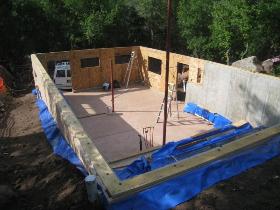
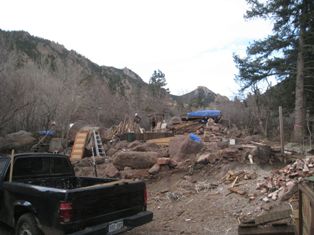
 When I woke this morning the snow was spraying down like little dots of slushy rain, and now, after my morning tea, it is coming down in huge chunks, straight down like falling bullets. It has been a rainy, snowy April, and our house project has been mired in the slipperiest, muckiest mud you can imagine. At the back of the house, and part way down the sides, is a 9 foot deep trench, where the tall concrete wall is wedged down into the hillside. The trench varies from about one to three feet wide, and the wall of dirt and rock overhead has been steadily crumbling and sliding down into the hole for about three weeks now, while we have dealt with all the things you have to do before the trench can be backfilled. I had no idea. In my mental picture of this stage, it was a quick and simple matter of getting the foundation poured, slapping up some waterproofing (two hours for two people, the waterproofing guy said on the phone), sticking up the foam, gluing together a few pipes for the foundation drain, and voila! On to the fun stuff with hammers and nails.
But not so fast, when you’re working with Miss Quality Assurance. Thanks to her watchful eye, you can be assured that the basement of our new home will be so super-insulated that no errant BTU will ever escape. In future rainstorms we will sleep deeply, knowing that no drop of water could possibly penetrate the watertight fortress that we spent weeks meticulously handcrafting.
The first omission in my abbreviated mental picture was chipping away all the bumps and ooze spots of concrete, so the foam insulation has a flat surface to stick to. Then there was the parging. Parging is a new word in my vocabulary that even spell check does not recognize, and I will be taking this opportunity to use it as many times as possible. As far as I know, PARGING is only appropriately used in the context of filling in all the little nail holes and bubbles in a concrete wall, so the waterproofing can be a continuous membrane. Because the walls are so tall and most places in the trench are too narrow and uneven for a ladder, the top sections have to be chipped and PARGED leaning over the wall on top of a ladder from the inside, belly pressed on the 8” wide wall and blood rushing to the head as you reach down to PARGE the little holes.
 My mental picture did not include me slipping and sliding through the back trench in the 35 degree rain yesterday, trying to glue the wet and muddy PVC together with frozen fingers. It did not include hauling buckets of gravel into the trench, up and over the protruding boulders, my soaking wet Carhartts leading me down that slippery slope to cotton-induced hypothermia. Normally, I would have been holing up inside for a rainy day, but the forecast was for the rain to turn into three feet of snow over the next few days, and if I could get the foundation drain in, I wouldn’t have to shovel that thing out one more time. It was ridiculously miserable, and at a certain point of absurdity it crossed that line into a certain kind of pleasure in seeing just how bad it could get. But after a couple of buckets of gravel I got smart and borrowed two laborers from the project next door. They came over in their Hefty bag rain ponchos and got the job done in an hour, which was the best $40 we’ve spent yet. Cheaper than a visit to the chiropractor, anyway.
The fun quotient of the past few weeks has been seriously reduced due to the fact that Rebecca was always the bearer of the news about all the pieces of work that I was not expecting, and therefore the recipient of a fair amount of resistance. Who knew that the sticky mesh that the stucco adheres to has to go on the top of each piece of foam BEFORE it goes up? Now we have to squirt canned foam into every little seam. Now we have to tape every seam. Now we have to brace the foam against the hillside because the caulk isn’t sticking. Now, Laura, you need to crawl on your knees for the entire length of the eight inch wide, ninety foot long wall to fill the nail holes in the rigid foam with the spray foam. Now, do it again to remove the tape that turned out to be a bad idea because the spray foam isn’t curing beneath it. Now crawl back again, this time on your belly, swinging your right arm like a windshield washer to wire-brush the foam so the sticky mesh will stick better. Did I mention that there are 3” anchor bolts sticking up from the wall every few feet? Now, scootch backwards on your butt (watch out for those anchor bolts!), unrolling a 19” roll of sticky mesh between your knees as you go.

This may have all been easier to swallow if we hadn’t just been through the gates of hell with the waterproofing, which was the blackest, foulest, stickiest stuff ever invented. Two coats of it, rolled on over our heads, slipping and sliding in the trench mud. It dripped everywhere, and everything stuck to everything. My glove was so firmly glued to the roller handle that I had to leave it there, and slipped my hand out when I needed to adjust my sunglasses- oops! goo on face- or my hat- oops! goo on hat. But no worries, Miss Quality Assurance was right there the whole time, so you can be assured that although everything in me was shouting to get this job over with, no tiny bubble holes were left untarred.
But its just about done, and once this snowstorm dumps its load, Chris and Ray will be back to fill the trench, and we’ll be one big step closer to the hammer and nails. The good news? The rigid foam is pink, and our house is looking very pretty, if you can overlook the mud. And my Carhartts are covered with tar, caulk, and dirt stains. I’m starting to look like a construction worker.





 Posts
Posts

