

On Monday, in two days, we start excavating. We were all set to start a week ago, but got a call the day before that Bob the Excavator’s mother had just died, and he needed to back out of the job. By now we’ve heard the dying mother, dying cousin, and dying vague relation excuse several times from subcontractors who haven’t called back, haven’t submitted their bid, or haven’t shown up for a meeting. But this time it was real- Bob was the kind of soft-spoken guy who would pause in conversation to bend down and caress a little clover plant, and who was fascinated by the delicate sand dollars that were laying on the back porch. Not the sort of guy who would lie about his mother. So we offered our condolences and spend last week getting three more excavation bids. We’ve lined someone up, but it’s too bad about Bob, because his gentle nature made the thought of ripping into this beautiful little piece of land much easier to bear.
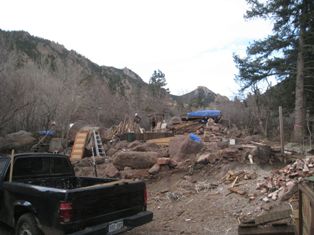
For the past few months, swarms of men in hard hats and filthy sweatshirts have been digging eight foot deep sewer trenches all over town. Huge yellow mammoth-machines have been crawling and scraping through the streets, grinding couch sized boulders in their steel teeth and spitting mounds of dirt and rock in their wake. So we’re well prepared for the loud crunches of steel on rock, for the constant roar of diesel engines, and the smell of fossil fuels in the air. It is easy, and painful, to think of this as violence against the earth, to think of the beautiful lichen-covered boulders as sentient beings uprooted from their rightful homes. Which is why we liked Bob so much, because we could create a different story, of a soft, fuzzy-grey haired man gently lifting the rock-people, bringing sunlight to those underground earthlings who hadn’t seen it for millions of years, and happily transporting them to a new flatland field where they would have fresh air forever and million dollar views of the front range.
It’s all in the story. Neither one is really the truth, so does it matter which one we choose? Sometimes, I think, it does. If I tell myself that the man holding a sign on the street corner is just trying to buy beer, or that he’s there because of personal failures or bad deeds, it allows me to turn away. If I tell a story of a decent human being in poor circumstances, I have to look a little closer. Who knows what the real truth is? But in this case, the story that leads to the most compassionate response is the one worth telling. And maybe it doesn’t even need a story; maybe the bottom line truth is just that this person is obviously suffering, no matter how he got there.
But I digress. On Monday, when I watch the backhoe bite into our land, I’m going to think of happy rocks being released into sunlight. I’m going to be grateful for machines that can accomplish a lifetime of shoveling into a week, and for the smiling, open-hearted men driving them. I’m going to think of toes wiggling down into the sand, of a little space on this earth opening up for us to live in, and of a grey-bearded, benevolent God gently patting the earth, saying “Here. Come sit right here.”
For the past few months, swarms of men in hard hats and filthy sweatshirts have been digging eight foot deep sewer trenches all over town. Huge yellow mammoth-machines have been crawling and scraping through the streets, grinding couch sized boulders in their steel teeth and spitting mounds of dirt and rock in their wake. So we’re well prepared for the loud crunches of steel on rock, for the constant roar of diesel engines, and the smell of fossil fuels in the air. It is easy, and painful, to think of this as violence against the earth, to think of the beautiful lichen-covered boulders as sentient beings uprooted from their rightful homes. Which is why we liked Bob so much, because we could create a different story, of a soft, fuzzy-grey haired man gently lifting the rock-people, bringing sunlight to those underground earthlings who hadn’t seen it for millions of years, and happily transporting them to a new flatland field where they would have fresh air forever and million dollar views of the front range.
It’s all in the story. Neither one is really the truth, so does it matter which one we choose? Sometimes, I think, it does. If I tell myself that the man holding a sign on the street corner is just trying to buy beer, or that he’s there because of personal failures or bad deeds, it allows me to turn away. If I tell a story of a decent human being in poor circumstances, I have to look a little closer. Who knows what the real truth is? But in this case, the story that leads to the most compassionate response is the one worth telling. And maybe it doesn’t even need a story; maybe the bottom line truth is just that this person is obviously suffering, no matter how he got there.
But I digress. On Monday, when I watch the backhoe bite into our land, I’m going to think of happy rocks being released into sunlight. I’m going to be grateful for machines that can accomplish a lifetime of shoveling into a week, and for the smiling, open-hearted men driving them. I’m going to think of toes wiggling down into the sand, of a little space on this earth opening up for us to live in, and of a grey-bearded, benevolent God gently patting the earth, saying “Here. Come sit right here.”




 Posts
Posts

